Commitments
What binds the country today: what each treaty brings, what it costs, what it demands and whom it binds. An unmet requirement is flagged. Leaving takes time, and has a price.
 PoliEconia
Windows · Steam · Early Access spring 2027
The Treaties menu is where the country's place in the world is negotiated: eight kinds of treaty to found, agreements to sign, proposals to accept or decline. And when a country refuses, it tells you why.
What binds the country today: what each treaty brings, what it costs, what it demands and whom it binds. An unmet requirement is flagged. Leaving takes time, and has a price.

Offers received, up to ten, each with its reason and its deadline: sign or decline. And the treaties founded by other countries, which you can ask to join.
Draft a treaty: its kind, its members, its entry conditions. If most invitees refuse, it does not happen; otherwise only those who accept join.

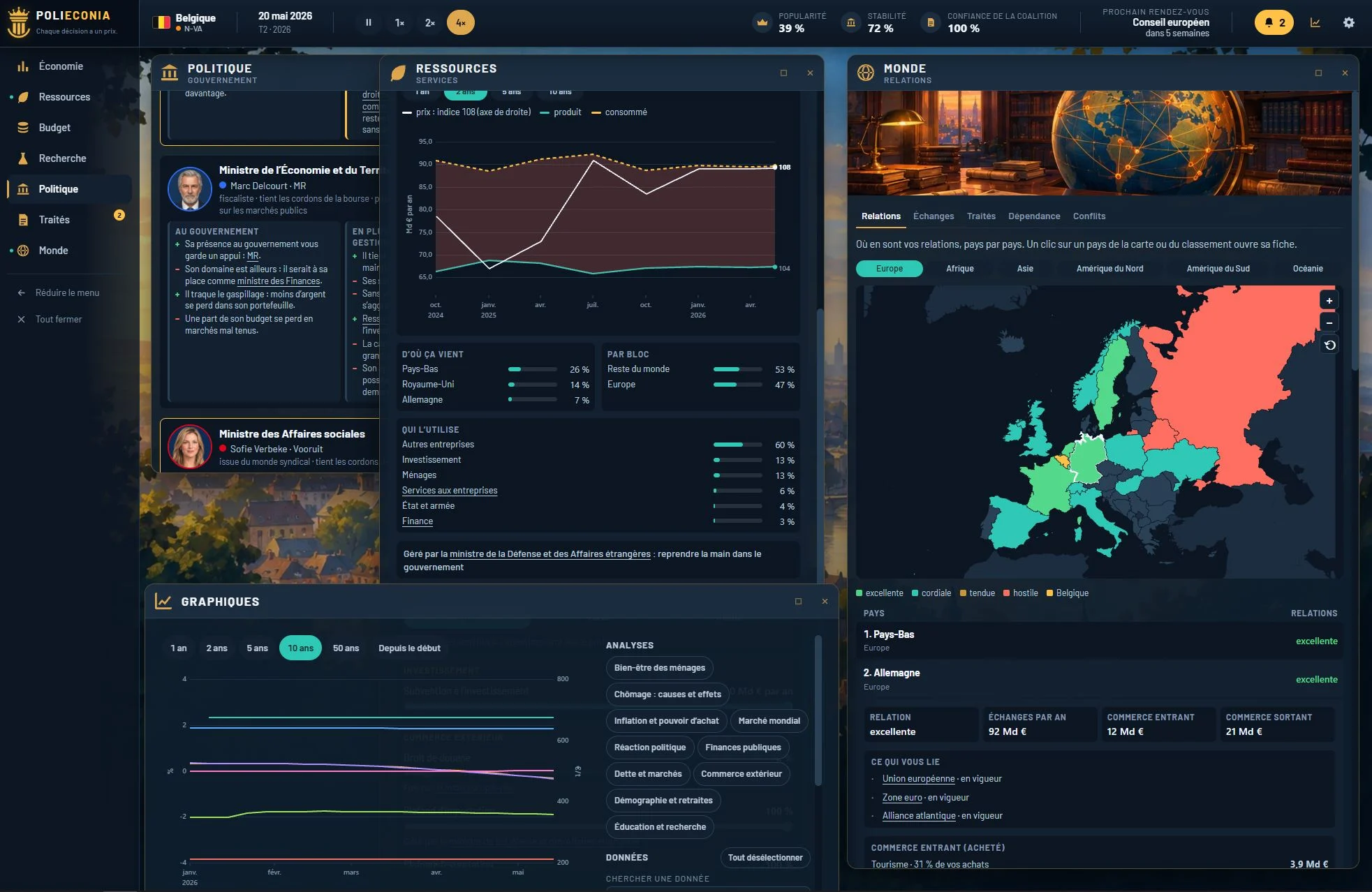
One relation with each of the other 113 countries, from hostile to excellent, with a filter by region, its change since the start of the game and the last twelve months of trade.
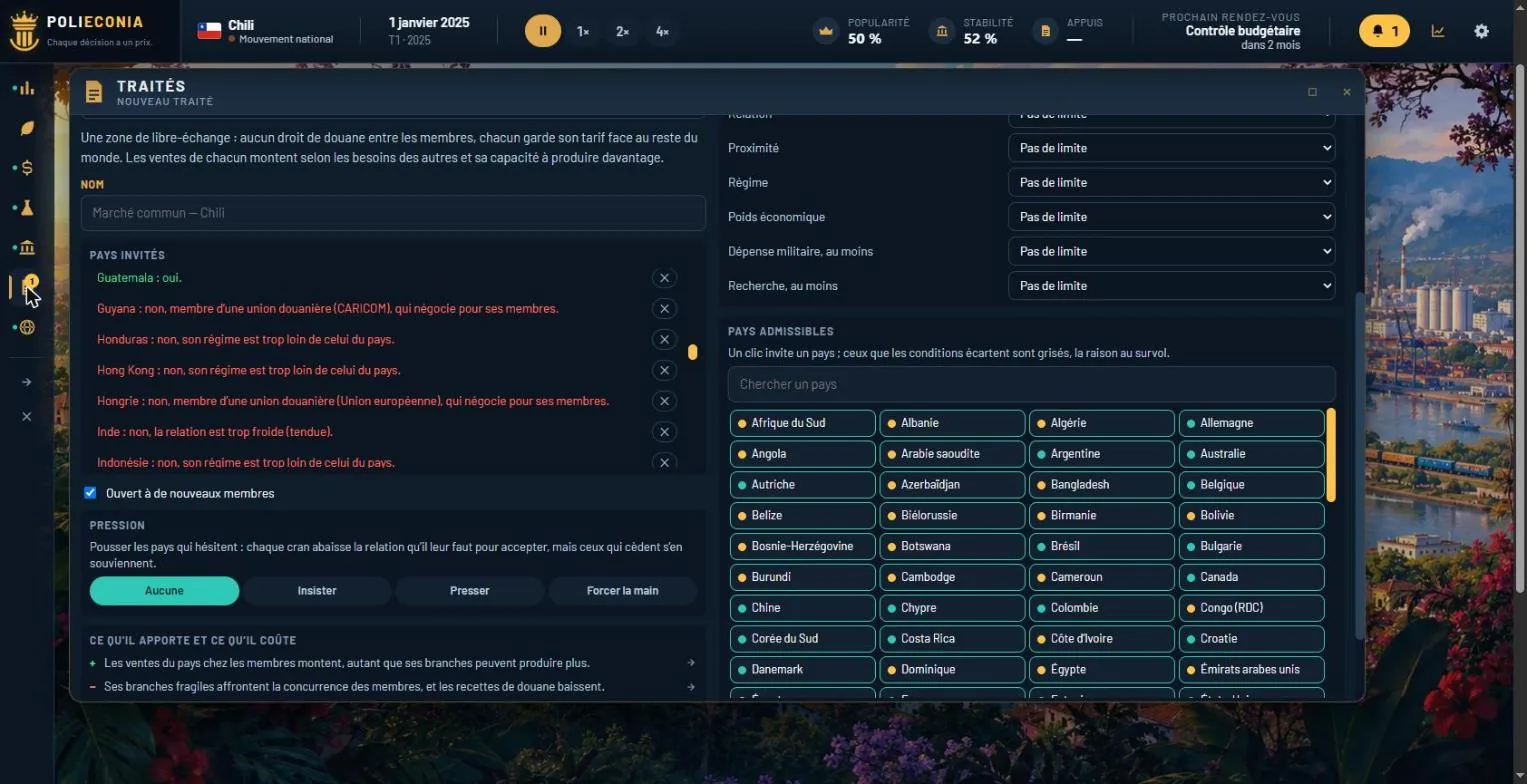
A treaty is drafted: you choose its kind, invite the countries and set the entry conditions. A minimum relation, proximity, a regime, an economic weight, a level of military spending or a research effort. It can stay open to new members, or closed.
Every invitee answers, and every refusal has its reason: relations too cold, trade too thin, regime too distant, member of a customs union that negotiates on its behalf, neighbour of the targeted country, incompatible laws or customs revenue at risk. You know what to fix before you come back.
And if you are in a hurry, there is pressure, in four steps, from none to forcing their hand. Each step lowers the required relation by ten points, and every country that gives in remembers: it costs you relations.
The game starts from the 37 real unions: 15 common markets, 8 customs unions such as the European Union, Mercosur or ECOWAS, 3 monetary unions, 3 alliances such as NATO, 7 organisations and the sanctions regime against Russia and Belarus.
They have their rules. A member of a customs union does not found a common market on its own: it is negotiated by the union. Nor does it set its own tariffs, fixed in common. But it can sign an economic partnership, which leaves tariffs untouched.
Recorded in test games on the development build, in November 2026: the numbers will change before release.
Yes: a strategy and simulation game for PC where diplomacy runs through treaties. Eight kinds to found, bilateral agreements, proposals from other countries, and a relation with each of the other 113.
Yes: a bilateral agreement, or a common market with several countries, with no tariffs between members. A member of a customs union, such as the European Union, negotiates it through the union.
It tells you: relations too cold, trade too thin, regime too distant, member of a customs union, neighbour of the targeted country, incompatible laws or customs revenue at risk.
You can press it, in four steps: each step lowers the required relation by ten points, but every country that gives in remembers.
Yes, with notice: twelve months for a common market, three months for the others. You can change your mind before the notice runs out.
Yes: they found one or two treaties a year, make you reasoned offers and vote on memberships. A membership passes with a majority of the votes cast.
PoliEconia is being tested on full playthroughs, country by country. Leave an address: one message when the game opens, nothing else, with a one-click unsubscribe link.