
Overview
Last year, this year and next year: the balance and the debt as a share of GDP, against the same budget with unchanged policy. For a European Union member, the deficit rule appears alongside.
 PoliEconia
Windows · Steam · Early Access spring 2027
The Budget menu puts a real country's government budget in your hands: twelve spending lines, seven revenue families, pensions, subsidies and the public debt. You draft it, parliament votes, and the economy responds.
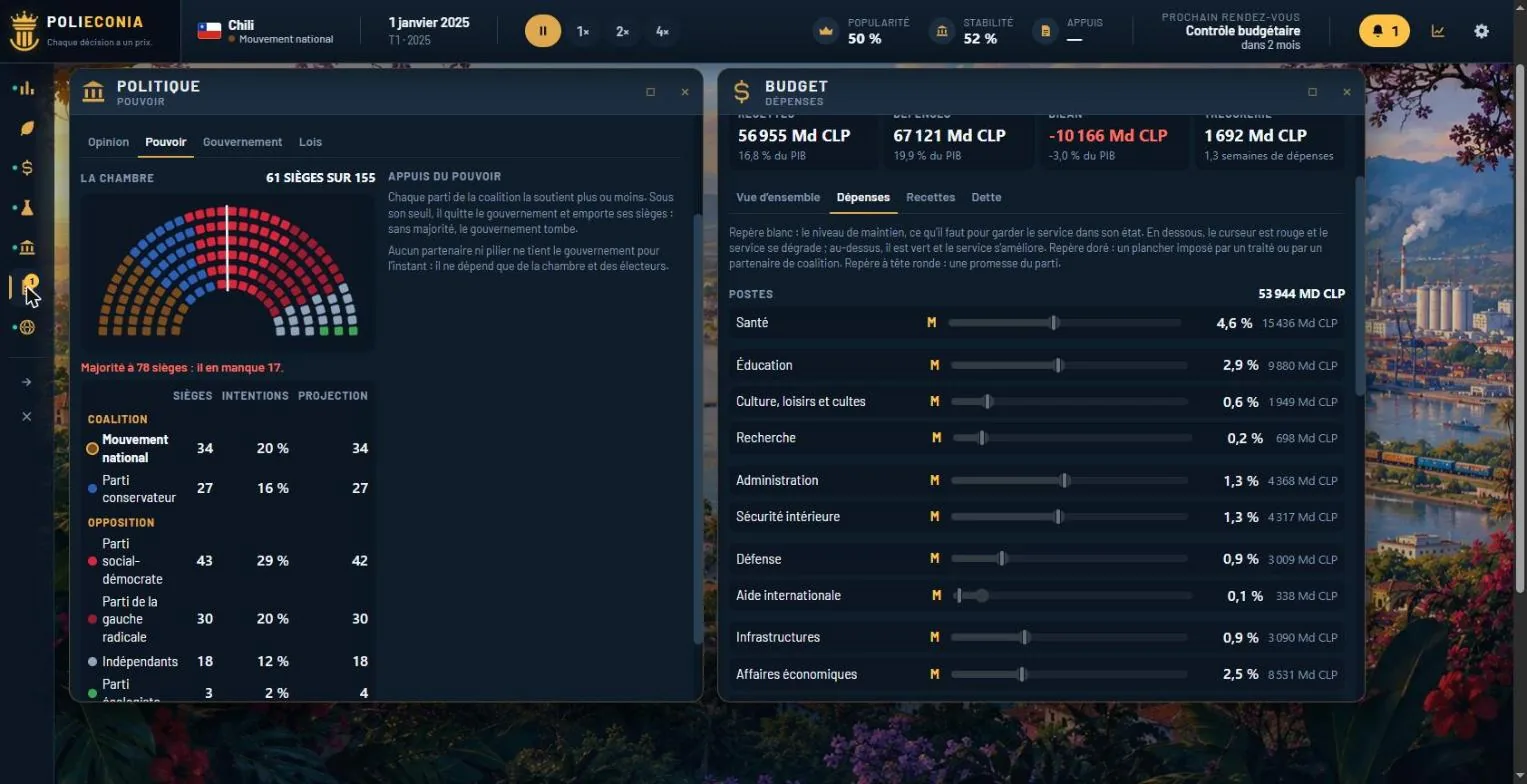
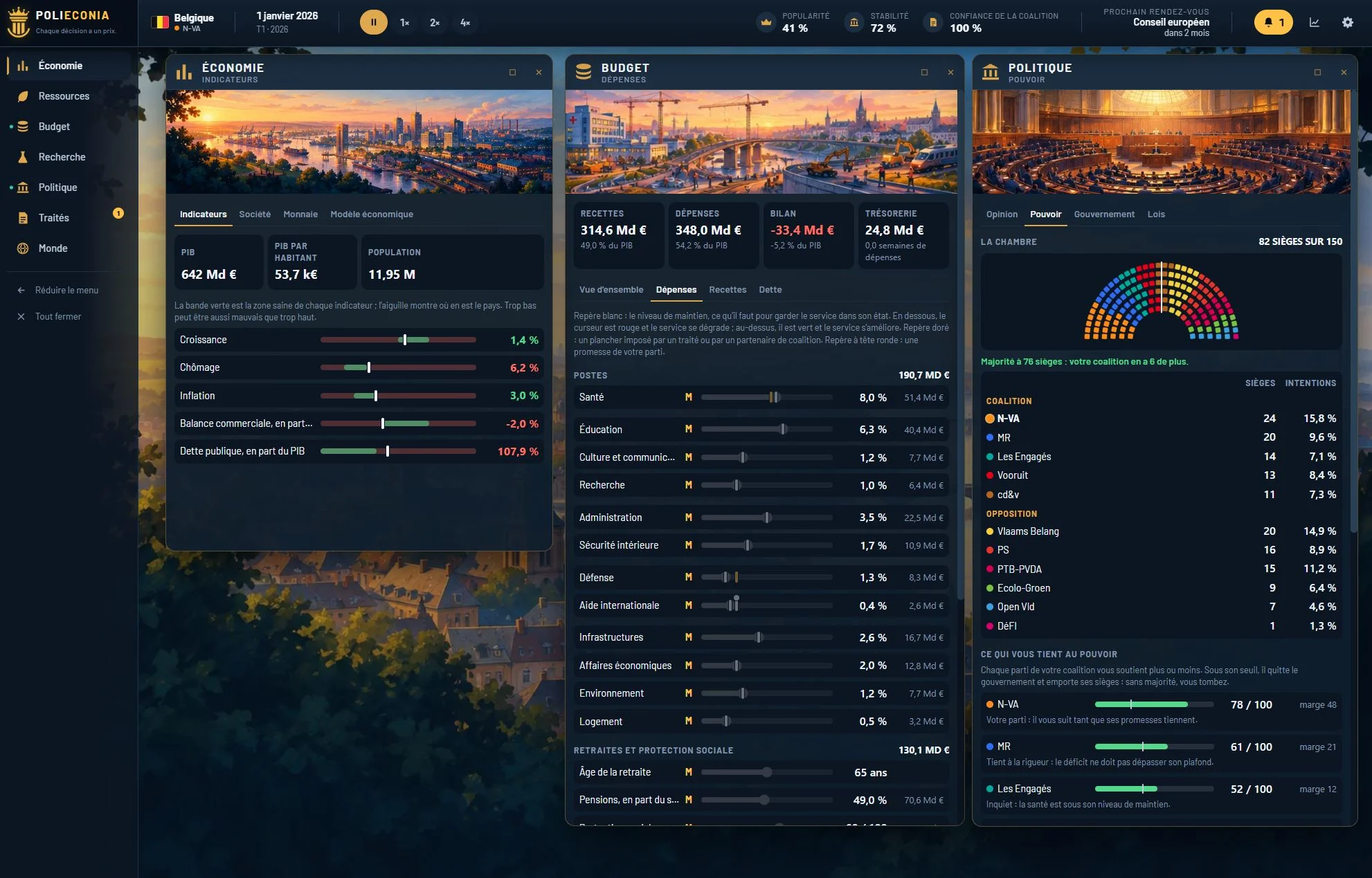
Last year, this year and next year: the balance and the debt as a share of GDP, against the same budget with unchanged policy. For a European Union member, the deficit rule appears alongside.

Twelve lines, from health to defence and foreign aid, sorted by the international classification of government functions. Plus pensions, unemployment, benefits and three subsidies: bread, fuel and electricity.

Seven families: income tax by class, social contributions, VAT at six rates, excise, the carbon tax, corporation and wealth taxes, and the means to fight fraud.

The outstanding stock, the rate paid and the market rate, interest per year, average maturity and the share in foreign currency. Then the next twelve months: what falls due, what must be borrowed, and at what rate.
The budget you table is voted by parliament seven game days later. The game tells you beforehand whether it will pass, and the settings stay frozen until the vote. Once adopted, revenue and spending change the same day; a new line settles in within a quarter, and a retirement age within two years. Without a parliament, the budget is decided on the spot.
Every slider carries its marks: the maintenance level, below which a service deteriorates; the floor set by a treaty or a coalition partner; and your party's promise. A partner can hold a red line that blocks the vote, and a broken promise costs votes.
The debt does not move on its own: the Debt tab breaks down what pushes it up or down, in points of GDP. The primary balance, the interest itself, growth and inflation. A debt that rises despite growth is a deficit that costs more than the economy brings in.
Every year, maturing debt and the deficit must be refinanced at the market rate. As long as lenders follow, the debt gets paid; when they stop, the game says so: "the market no longer lends". And a default ends the game.
Mechanisms of the development build of the game.
Yes. The Budget menu covers twelve spending lines, pensions and benefits, three subsidies and seven revenue families, including VAT at six rates. Starting amounts are calibrated on the country's official accounts.
It moves with the primary balance, interest, growth and inflation, which the game breaks down in points of GDP. Every year you must borrow enough to cover maturing debt and the deficit, at the market rate.
Yes. If lenders stop following, the game says so: the market no longer lends. A default ends the game.
Yes, by parliament, seven game days after it is tabled, and the game tells you beforehand whether it will pass. A coalition partner can hold a red line. Without a parliament, the budget is decided on the spot.
Yes, from 55 to 70. The reform goes through the budget vote and settles in over two years.
Yes. Every setting can be kept or handed over, or everything handed over at once. A minister follows their party's line, and asks you to decide if their changes risk being rejected or breaking a promise.
PoliEconia is being tested on full playthroughs, country by country. Leave an address: one message when the game opens, nothing else, with a one-click unsubscribe link.