

PoliEconia
PoliEconia

Windows · Steam · Early Access spring 2027

The Economy menu An economic simulator at the scale of a country: growth, inflation, currency

The Economy menu is the country's dashboard: eight gauges, society, currency and the economic model. It shows where the country stands, what drives it and what holds it back, before you decide elsewhere.

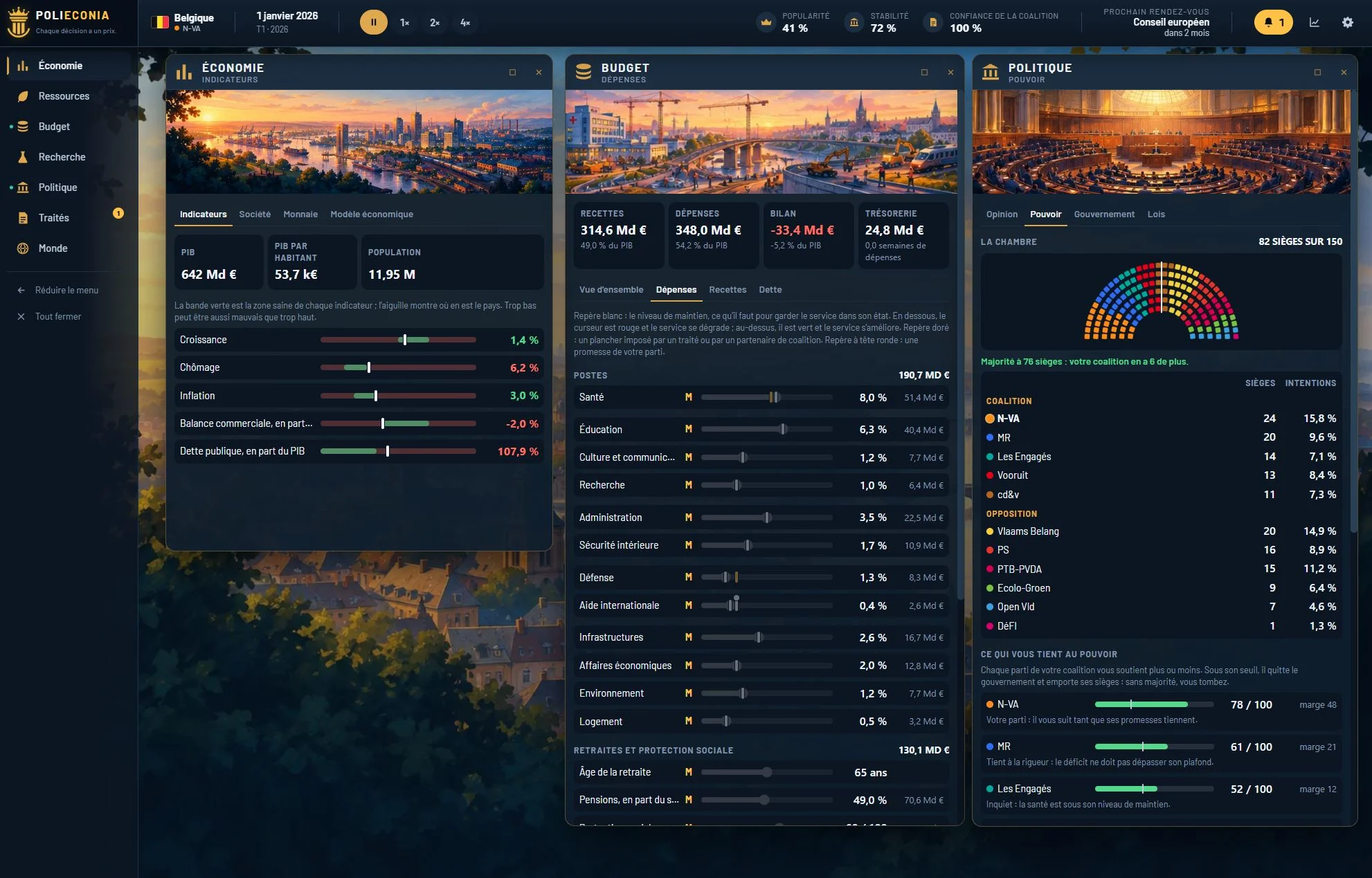
Three PoliEconia windows: the economic indicators, budget spending line by line, and the chamber with each party's seats
The economic indicators next to the budget and the chamber: the country at a glance, and every gauge opens onto its details.
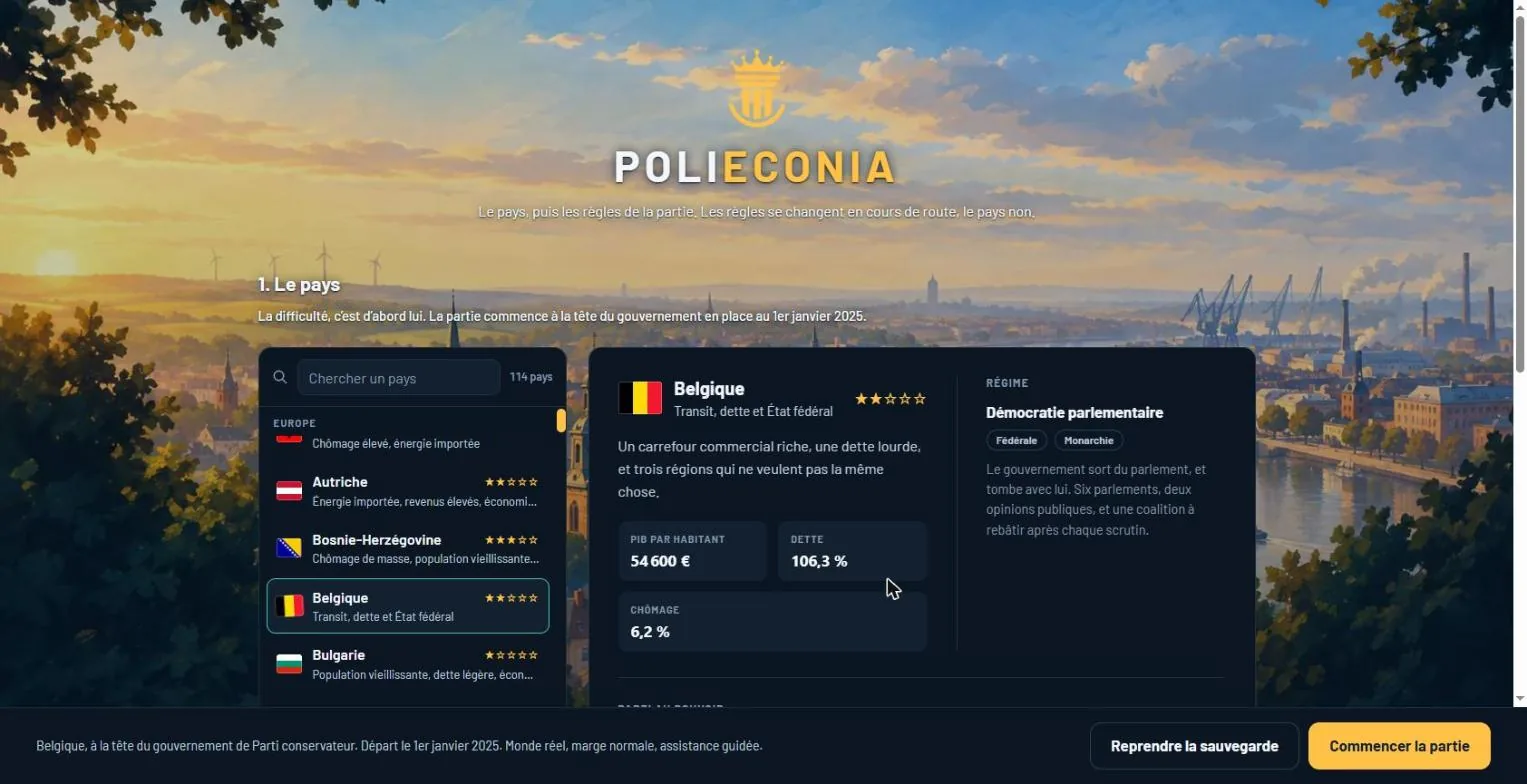
The PoliEconia start screen: the list of 114 countries, and Belgium's card with its regime, GDP per capita, debt and unemployment
The start screen: each country's card gives its regime, GDP per capita, debt and unemployment, from IMF accounts.

Four tabs, not one more

A port city and its factories at sunset: the game's Indicators banner

Indicators

GDP, GDP per capita and population, then eight gauges: growth, unemployment, inflation, current account, public debt, interest paid on the debt, purchasing power and shortages. Each one shows a healthy zone, the country's needle and the median of its region.


A busy market square in front of a hospital and buildings: the game's Society banner

Society

Poverty, at the World Bank line, the same for every country; inequality, as how many times more the richest fifth earns than the poorest; and three income classes, low, middle and high, with their share of income.

A columned central bank, stacks of coins and banknotes: the game's Currency banner

Currency

The exchange-rate regime, floating, pegged or in a monetary union; the dollar rate; foreign reserves in months of imports, with an alert below three months; and the IMF line, when a programme is offered or under way.

A business district, a palace and a factory by a river: the game's Economic model banner

Economic model

A scale from 0 to 100, from state control to free market, with the private share of the economy. Two blocks spell out what each side brings, and what it costs.

Eight gauges to read a country

Every gauge has its healthy zone: the same for all advanced economies on one side, for all emerging ones on the other. The needle shows where yours stands, and a gold mark shows the median of its region. A country can have inflation that is normal for its region and dangerous for its economy: the game shows both.

Click to open the details. For inflation: the central bank's target, the policy rate, and the share of each cause, wages, commodities, import prices and the exchange rate, supply strains and taxes, with the price of electricity, fuel and food since the start of the game. For shortages: the energy and food the country could not supply.

The starting figures come from the IMF, the World Bank, the OECD and the UN; the engine then moves them month by month, according to your choices.

What you set here, and elsewhere

The policy rate
If the currency floats, a slider from 0 to 40%, in quarter-point steps, between "support activity" and "curb prices". A white mark shows the rate the central bank would set on its own.
Devaluation
If the currency is pegged, devalue it by 20% in one go. The game asks for confirmation: it cannot be undone, and the running total stays on screen.
The private share
It moves when you nationalise or privatise an industry, through a vote, in the Resources menu.
The debt
Its stock, its cost and its creditors are followed and managed in the Budget menu.

From one country to the next

Starting situations in the development build of the game.

Questions about the economy in PoliEconia

Is PoliEconia an economic simulator?

Yes: an economic simulator and management game for PC, at the scale of a country. The economy starts from the country's official accounts, then moves every month with your decisions, your partners' and the state of the world.

Can you set interest rates?

Yes, if the country's currency floats: the policy rate goes from 0 to 40%, and the game shows the one the central bank would have chosen. In a monetary union such as the euro area, the rate is set by the common central bank.

Can you devalue the currency?

Yes, if it is pegged: a 20% devaluation, in one go. The game asks for confirmation, because it cannot be undone.

How does the game measure poverty and inequality?

Poverty follows the World Bank line, 3 dollars a day at purchasing power parity, or half the median income if that is higher: the same for every country. Inequality compares what the richest fifth earns with what the poorest earns.

What does "economic model" mean?

The place of the private sector and the state in the economy, on a scale from 0 to 100. It changes when you nationalise or privatise an industry, through a vote, in the Resources menu.

Can the IMF step in?

Yes. An IMF loan may be offered to you; it arrives as a decision to make. During a programme, the Currency tab tracks the amount drawn against the amount granted, and whether the conditions are met.

Get notified at launch

PoliEconia is being tested on full playthroughs, country by country. Leave an address: one message when the game opens, nothing else, with a one-click unsubscribe link.

Your address is stored in the European Union and never passed on to third parties. Your data