

PoliEconia
PoliEconia

Windows · Steam · Early Access spring 2027

The Politics menu A political simulator: opinion, parliament, ministers and laws

You are the head of government. Your ministers run things, you decide. The Politics menu shows who supports you, who keeps you in power, and what it costs to get a law through.

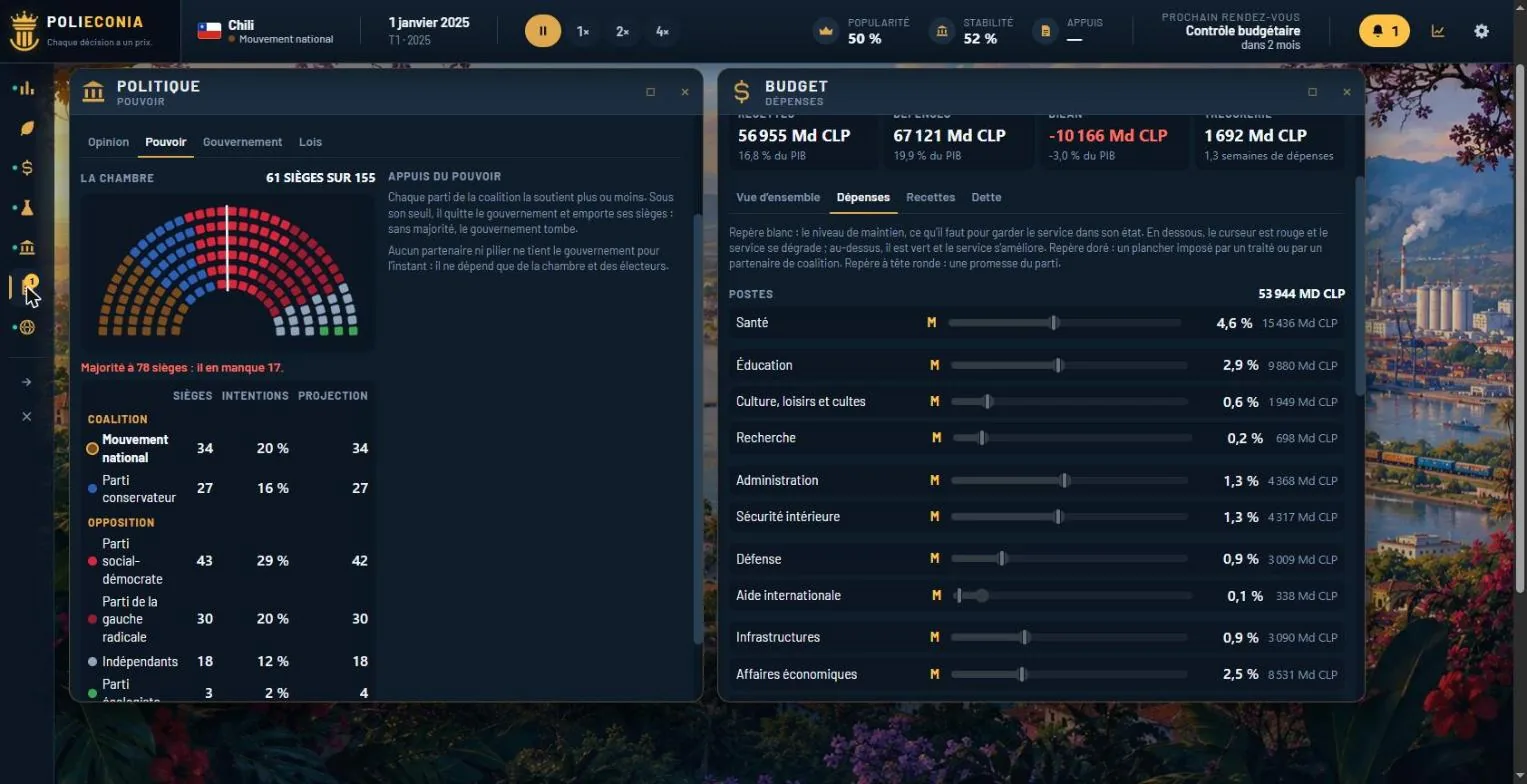
Two PoliEconia windows: Chile's chamber with each party's seats, and the spending budget with its sliders held by the ministers
Chile's chamber, seat by seat, next to the budget whose sliders the ministers hold: every decision is counted in votes.
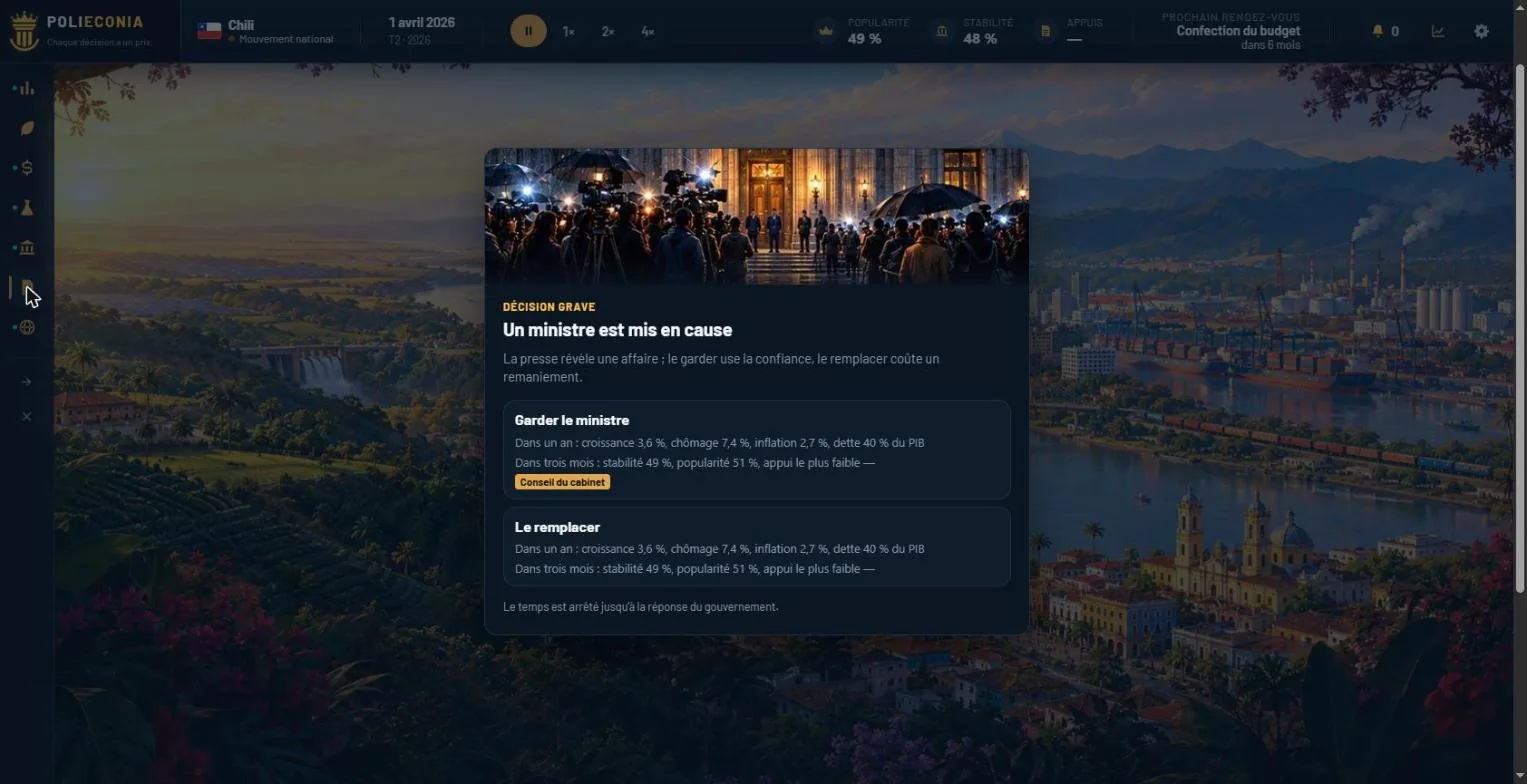
A major decision in PoliEconia: a minister implicated by the press, two possible answers, each priced at one year and at three months
A major decision: time stops, and the cabinet prices each answer at one year and at three months before you decide.

Four tabs, the whole of power

A crowd gathered with placards in front of a dome: the game's Opinion banner

Opinion

The country's popularity and stability, then six groups: three income classes, the young, pensioners and business, with the share that supports you, its change over a year and your record in office. Below a certain level of stability, unrest breaks out.
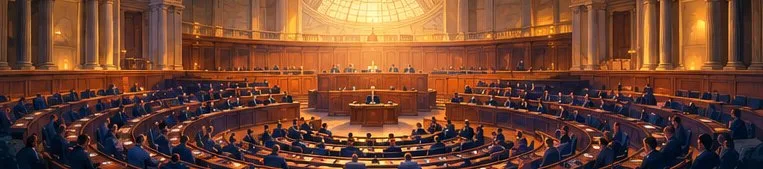

A parliamentary chamber with full benches: the game's Power banner

Power

The chamber, seat by seat: majority, coalition and opposition, and the projection if the election were held tomorrow. Each partner's support, with the threshold below which it leaves the coalition.

A cabinet meeting around a long table: the game's Government banner

Government

Eleven portfolios and their ministers, each with a profession and a character. A minister in their own field performs better; a minister left free follows their party's line.

Scales, a gavel and bound law books: the game's Laws banner

Laws

Around thirty laws in six families: labour, economy and regulation, family and morals, civil liberties, order and defence, borders. From the minimum wage to the death penalty, from the right to strike to cannabis.

How you lose power

There is no imposed goal: you govern for as long as you hold on. And there are many ways to fall: a lost election, a refused vote of confidence, a term limit, a party that drops you, a coup or a palace revolution, or a default.

Elections follow the country's real calendar, then every end of term, and the vote is a verdict: each group judges what your term brought it. A partner leaving the coalition triggers a snap election forty days later. In a regime without a parliament, it is no longer parties that keep you in place, but pillars: the army, the security services, the technocrats.

Time stops for major decisions

Eleven situations force a decision: a natural disaster, a pandemic, mass protests, a general strike, an army growing restless, a partner threatening to leave, a minister's scandal, sanctions against the country, foreign reserves running dry, a closed debt market, a banking crisis.

Time stops until you answer. The cabinet prices each option: at one year, growth, unemployment, inflation, debt and the budget balance; at three months, stability, popularity, the weakest support and the hardest-hit group. Then it gives its advice. The decision stays yours.

Your political levers

Pass a law
The chamber votes seven days after it is tabled, with a forecast beforehand. One social law per quarter, and two thirds of the seats for a heavy law in the countries with the strictest rules.
Force it through
Possible, but it costs 5 points of stability, double for a heavy law, and votes at the next election.
Dissolve
No earlier than a year after the last election; the vote takes place two months later.
The vote of confidence
Won, it gives your partners ten points of support for a year; lost, the government falls.
Delegate or take back
Each portfolio can be handed to its minister, or all at once. They get their changes voted, and ask you to decide if those risk being rejected or breaking a promise.
Replace a minister
A new minister needs six months to settle in, two years for a novice; the partner concerned holds it against you for a year.

From one regime to another

Mechanisms of the development build of the game. Parties are political families with generic names, not real parties.

Questions about politics in PoliEconia

Is it a prime minister simulator?

In a way: you lead a real country's government. In a parliamentary democracy that makes you prime minister; elsewhere, you hold the government under the country's own regime. You must keep a majority, manage your partners and win elections, while running the economy.

Can you lose the game?

Yes: a lost election, a refused vote of confidence, a term limit, a party that drops you, a coup, a palace revolution or a default all end the game.

Are there elections?

Yes, on the country's real calendar and then at every end of term, not counting snap elections. The vote judges your record in office for each group of the population.

Are the parties real?

No: they are archetypal political families with generic names, such as a conservative party or a national movement. The starting seats, however, follow the country's real chamber.

Which laws can you pass?

Around thirty, in six families: minimum wage, working hours, the right to strike, labour immigration, military service, abortion, end of life, the death penalty, cannabis, asylum… They go through the chamber vote, or by decree in a closed regime.

Can you hand the government to your ministers?

Yes, portfolio by portfolio or all at once. Each minister follows their party's line, and the heavy decisions always come back to the head of government.

Get notified at launch

PoliEconia is being tested on full playthroughs, country by country. Leave an address: one message when the game opens, nothing else, with a one-click unsubscribe link.

Your address is stored in the European Union and never passed on to third parties. Your data